The manager staggered back a step.
Manager: “That’s not possible… we were told she died.”
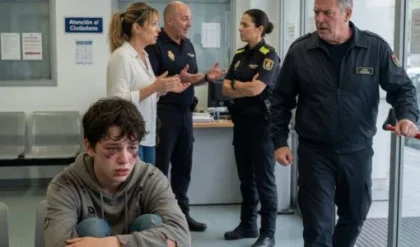
The boy’s tears slowed.
He wiped his face with the back of his hand, breathing unevenly.
Boy: “She told me… you told everyone that…”
The words landed like something heavy breaking through the surface.
Silence fell.
Not the polite silence from before.
This was different.
Thick. Uncomfortable. Real.
The rich woman slowly lowered her phone.
No one laughed now.
The old man’s hands shook as he crouched down despite the strain it clearly caused him. His eyes searched the boy’s face, as if trying to find pieces of someone he had lost.
Old Man: “Where is she now?”
The boy swallowed hard.
Boy: “She’s… she’s sick.”
His voice cracked again, softer this time.
Boy: “She works… she tries to… but she gets tired a lot. She coughs. Sometimes she can’t get out of bed…”
The old man closed his eyes.
Pain crossed his face so openly that several people turned away.
Manager: “This… this can’t be right…”
But her voice lacked conviction now.
The boy looked at her.
Not with fear anymore.
But with something else.
Boy: “She said this place used to be hers too.”
Another silence.
He reached into his backpack again and pulled out the folded paper the manager had dropped earlier. This time, he held it tighter.
Boy: “She told me to bring this… if I ever needed help.”
The old man took it slowly.
His hands trembled as he opened it.
His eyes moved across the words—
Then filled with tears.
Old Man: “She came back…”
He looked up at the manager.
Old Man: “She came back here, didn’t she?”
The manager couldn’t answer.
Her hands shook visibly now.
The old man’s voice hardened, grief sharpening into something heavier.
Old Man: “What did you do?”
No one moved.
No one spoke.
Because for the first time, the perfect showroom—the flawless lighting, the polished marble, the carefully controlled silence—was cracking.